 Tối hôm qua, tui ngủ không được ngon cho lém… có được 6 tiếng thui ㅠㅠ… vì một lẽ là tui có kỳ thi tổng kết! Tui có 3 môn phải ôn, một trong số đó là môn virus. Thật ra, tui đã học môn này từ 2 năm trước và tui có ấn tượng rất tốt về môn này, không phải vì thầy dạy môn này mà vì cuốn sách thầy đã chọn để dạy. Tác giả của cuốn sách là một giáo sư đã về hưu tên là Lauren Sompayrac. Ông ta viết theo một phong cách rất tự nhiên và không trang trọng làm cho cuốn sách trở nên như cuốn truyện chứ không như một cuốn sách khoa học cứng nhắc… Lúc đó, tui thích cuốn này lém, tui đã đọc hết trong vòng 1 tháng điều mà tui chưa từng làm nổi trước kia với những cuốn sách khoa học… hehe. (Nhưng chưa đọc lẹ và say mê bằng “7 viên ngọc rồng” hay Doreamon đâu ^^)
 Yesterday night, I did not sleep very well… just about 6 hours ㅠㅠ… because of my final examination! I had three subjects need to be reviewed, one of them is a subject of virus. Actually I studied this subject two years ago and I really liked the book which professor chose to teach us. The author was a retired professor named Lauren Sompayrac, he wrote in informal tone that make this book seems to be a story book than a tough scientific one… I really loved it and at that time, I read all the book completely within one month that I haven’t done before with a science book… hehe.
Mặt khác, trong thời gian gần đây, hàng loạt các nước trên thế giới đang phải đối đầu với đại dịch H1N1 và vấn đề này đang được quan tâm một cách cẩn trọng mỗi giây đồng hồ… Trong khi đó, hôm qua tui phải coi lại quyển sách virus 1 lần nữa… Tui vẫn cảm thấy nó rất thú vị. Tác giả cho mỗi con virus 1 cái tên dựa vào bản chất của nó (hehe giống như xem mặt đặt tên ^^). Trong số đó, virus cúm được đặt tên là “Mồi Nhử và Biến Hình”… Hôm nay tui có nhã hứng xem xét con virus này lại một cái để hiểu kẻ thù hiện tại một tẹo…
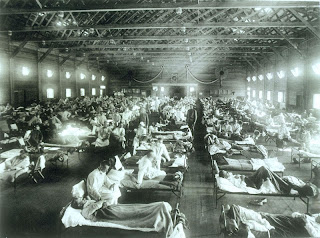
(Đại dịch cúm Tây Ban Nha 1918 với khoảng 50-100 triệu người chết trên thế giới
Spanish flu in 1918 killed from 50 to 100 million people in worldwide)

(Dịch cúm gia cầm vửa qua cũng gây khá nhiều người thiệt mạng
The recent Avian flu pandemic also left many death cases)
On the other hand, in these days, a lot of countries in the world now are suffering the H1N1 pandemic and this problem is being looked over seriously in every second… And yesterday, I needed to look over this book a gain… I still feel it very interesting. The authors gave a nick name for every virus depending on its characteristics. Among these viruses, Influenza virus A was given a name “A Bait and Swich Virus”… hehe let’s review this virus to understanding a our current enemy better…

(Influenza A Virus)
Cúm là một bệnh truyền nhiễm gây bời virus có bộ gen là RNA thuộc họ Orthomyxoviridae. Triệu chứng thường gặp là ớn lạnh, sốt, đau cổ, đau cơ, nhức đầu nặng, ho, yếu sức,… Orthomyxoviridae là họ virus có bộ gen là RNA bao gồm 5 chi: Influenzavirus A, Influenzavirus B, Influenzavirus C, Isavirus và Thogotovirus. Ba chi đầu tiên gây cúm ở động vật có xương sống bao gồm chim, người và động vật có vú khác. Và H1N1 thuộc chi Influenzavirus A (Virus cúm A)…

(H1N1 trở nên kháng với Oseltamivir - một loại thuốc đặc trị cho cúm
H1N1 become resistant to Oseltamivir - A drug is used for flu)
Influenza, commonly referred to as the flu, is an infectious disease caused by RNA viruses of the family Orthomyxoviridae. The most common symptoms of the disease are chills, fever, sore throat, muscle pains, severe headache, coughing, weakness and general discomfort. The Orthomyxoviridae (orthos, Greek for "straight"; myxa, Greek for "mucus") are a family of RNA viruses that includes five genera: Influenzavirus A, Influenzavirus B, Influenzavirus C, Isavirus and Thogotovirus. The first three genera contain viruses that cause influenza in vertebrates, including birds (see also avian influenza), humans, and other mammals. And H1N1 virus belongs to Influenzavirus A…
Bộ gen của virus cúm A bao gồm 8 đoạn RNA đơn mã hóa cho 11 loại protein (HA, NA, NP, M1, M2, NS1, NEP, PA, PB1, PB1-F2, PB2). Toàn bộ gen có kích thước là 13.588 base. Để phân biệt các chủng virus cúm A, người ta dựa vào loại kháng nguyên của protein HA (hemagglutinin) và protein NA (neuraminidase). Cho đến lúc này, người ta phát hiện ra có 16 kháng nguyên của protein HA (từ H1 đến H16) và 9 loại kháng nguyên của protein NA (từ N1 đến N9). Tuy nhiên các chủng virus cúm ở người chỉ phổ biến với kháng nguyên H1, 2 và 3; N1 và N2… lý do seo đây te?!

(Cấu trúc của virus Influenza A - Influenza A virus structure)
The Influenza A virus genome is contained on eight single (non-paired) RNA strands that code for eleven proteins (HA, NA, NP, M1, M2, NS1, NEP, PA, PB1, PB1-F2, PB2). The total genome size is 13,588 bases. To distinguish the Influenza A viral types, the types of protein HA (hemagglutinin) and protein NA (neuraminidase) were used as markers. Until now, 16 different H antigens (H1 to H16) and 9 different N antigens (N1 to N9) were identified but only H 1, 2 and 3, and N 1 and 2 are commonly found in humans… why just these…?!

(Chu kỳ nhiễm của virus cúm A - Infection cycle of Influenza A virus)
Để virus cúm nhiễm vào tế bào, protein trên bề mặt virus là hemagglutinin phải được nhận dạng và gắn vào thụ quan trên bề mặt tế bào (giống như chìa khóa gắn dzô ổ khóa). Mặc dù, biết là thụ quan của hemagglutinin là sialic acid (tên khác là neuraminic acid) nhưng phân tử nào trên bề mặt tế bào gắng với sialic acid (có thể là glycoprotein hoặc glycolipid) chưa được làm rõ. Do vậy, có thể chỉ có 3 loại trên của hemagglutinin (H1, 2 và 3) là gắng vừa thụ quan trên tế bào người…

(Hemagglutinin giống như cái chìa khóa, vừa vặn với thụ quan trên bề mặt tế bào, giúp virus xâm nhập tế bào)
Hemagglutinin looks like a key, fit with the lock (receptor) on the cell membrane to enter the cell)
For influenza to infect a cell, a protein on the surface of the virus called the viral hemagglutinin must “plug into” a receptor on the surface of the target cell. Although it is known that the “socket” for the hemagglutinin protein is a sialic acid (neuraminic acid) residue, the cell surface molecules to which these sialic acids are attached (either a glycoprotein or a glycolipid) have not been identified. So maybe just three types of hemagglutinin (H 1, 2 and 3) are fit to plug into human cells’ receptors…
Thật ra, hemagglutinin giống con dao hai lưỡi bời vì khi virus cúm bắt đầu rời khỏi tế bào thì chính cái này gây cho nó trục trặc đây. Trên bề mặt virus có hemagglutinin còn trên bề mặt tế bào có sialic acid nên sự dính nhau của hemagglutinin và sialic acid giúp virus xâm nhập tế bào nhưng giờ đây lại bắt dính virus không cho rời khỏi. Do vậy, để xử lý chuyện này, virus cần phải dùng enzyme tên là neuraminidase để cắt hết các asilic acid trên bề mặt tế bào để virus thoát ra. Qua đây chúng ta có thể suy luận là có thể chỉ có neuraminidase loại 1 và 2 (N1 và N2) là thích hợp để làm việc này trên tế bào người…

(neuraminidase giống như dao cạo, giúp cắt sạch sẽ sialic axi1t bám trên bề mặt tế bào
neuraminidase looks like a razor to shave all the sialic acid located on cell membrane)
Actually, hemagglutinin is also a double-edged sword because when influenza virus particles get ready to exit an infected cell, they face an “escape” problem. This difficulty arises because the infected cell has receptors on its surface that contain sialic acid molecules to which the hemagglutinin protein of the virus can bind (that’s how the virus entered the cell). As a result, exiting viruses can be “captured” by the infected cell when the viral hemagglutinin molecules “re-bind” to the hemagglutinin receptors on the cell surface. This “neuraminidase” protein functions as a “razor” that enzymatically shaves off sialic acid residues from the surface of an infected cell. Once these sialic acid molecules have been removed, viruses can bud through the “shaved” membranes and escape, unencumbered by the sticky receptors. So we can deduce that because the neuraminidase type 1 and 2 are only suit to take this work in human cells…

Beside of this trick, this virus also use another more dirty trick to accelerate there infection process. During synthesis of its messenger RNA (mRNA), virus wants the cellular transcription machinery must only focus on its mRNA. So, viral proteins actually bite off one end of cellular mRNA molecules that are present in the cell’s nucleus, and use these snippets of RNA to begin synthesis of viral mRNAs. The pieces of cellular messenger RNA that are “stolen” by the virus contain the “cap” structure that ribosomes need to initiate protein synthesis. Because cellular mRNAs whose caps have been stolen can’t be translated into protein, cap stealing not only provides the virus with a ready-made cap “for free,” it also helps focus the protein synthesis machinery of the cell on the production of viral proteins.
Virus chơi dơ ghê hé… nhưng tại sao chúng ta lại rất khó tiêu diệt chúng một cách triệt để?! Bởi vì chúng rất lương lẹo… bộ gen của nó có thể dễ dàng biến đổi làm hệ miễn dịch của chúng ta không thể nhận mặt kịp…
Hix, how dirty this virus is… But why we can not eliminate them efficiently?! Caused it was too clever to catch up… their genenome is very easily to be mutated…
Thường thì virus cúm sẽ nhử mồi hệ miễn dịch, khi hệ miễn dịch nhận diện ra nó (tốn thời gian à nha) và chuẩn bị tấn công thì nó liền biến hình thành chủng khác, làm cho hệ miễn dịch lúng túng không thể nào bắt kịp nó. Bằng cách này nó có thể nhiễm lại người đã bị nhiễm trước đó nhưng với 1 bộ mặt mới (hehe, bình mới rượu cũ ^^)

(Virus cúm có khả năng tự làm mới bằng cách đột biến... nên mỗi nó có thể nhiễm đi nhiễm lại một vật chủ mà hệ miễn dịch vẫn không nhận ra...
Influenza A virus can renew everytime by mutation... so it can infect over and over but the immune can not recognize...)
The influenza virus offers the immune system one strain to defend against, and then when this “bait” has been taken, it uses its capacity to mutate to “switch” to another strain which the immune system has never seen. The effect of this “antigenic drift” is that individuals with “outdated” antibodies provide a pool of individuals who, although they are immune to the original virus, can be “reinfected” by a mutant strain which arose during infection of another individual.
Bình thường, người hiếm khi nào nhiễm bởi virus cúm từ gia cầm, bởi vì loại virus này có khả năng xâm nhiễm rất yếu ở tế bào người. Tuy nhiên, heo có thể là vật chủ trung gian của cả 2 loại virus cúm của người và của chim (nói cách khác, virus cúm của người và chim đều có thể nhiễm trên heo). Và thỉnh thoảng 2 loại virus này có thể cùng nhiễm trong cùng 1 tế bào của heo và chúng có thể tái tổ hợp bộ gen với nhau để tạo ra 1 chủng virus mới với 1 phần từ virus cúm người, 1phần từ virus cúm chim. Do vậy, khi virus tự đột biến bộ gen của nó (như nói ở đoạn trên ) thì sự thay đổi không có gì đáng kể, hệ miễn dịch còn có khả năng nhận biết được… nhưng nếu virus đột biến theo kiểu này (kết hợp với các chủng virus họ hàng xa, từ người, từ chim, từ heo,…), chúng trở nên hoàn toàn khác, chúng sẽ có những kháng nguyên mới mà hệ miễn dịch của con người khó mà chống chọi và gây nên đại dịch.

(Heo là vật chủ trung gian giúp cho việc biến hình từ sự tái tổ hợp các loại virus họ hàng xa
Pig is a mediate host which facilitate the recombination of many kind of viruses)

Humans are rarely infected directly by avian influenza Aviruses, because these bird viruses usually reproduce poorly in human cells. However, a pig can be a host to both avian and human influenza A viruses, and occasionally viruses of both origins infect the same pig cell. When this happens, new viruses may be produced that are part human virus and part bird virus. Since the strains produced by drift will still be reasonably similar to the older strains, people’s immune still can regconize them. In contrast, when influenza viruses reassort, they acquire completely new antigens—for example by reassortment between avian strains and human strains; this is called antigenic shift. If a human influenza virus is produced that has entirely new antigens, everybody will be susceptible, and the novel influenza will spread uncontrollably, causing a pandemic.

(Sự khác nhau tí xíu khi virus tự đột biến và gần như khác nhau hoàn toàn khi đột biến bằng tái tổ hợp
Just a little bit difference in viral self-mutation and BIG diffenrence when recombination-mutation)
Chủng virus H1N1 hiện giờ đang hoành hành được cho là kết quả của sự tái tổ hợp của virus cúm người và heo…
And 2009 H1N1 strain appears to be a result of reassortment of human influenza and swine influenza viruses, in all four different strains of subtype H1N1...
Tốc độ nhiễm quá nhanh của virus cũng là một vấn đề đau đầu hiện nay. Loại virus này lây nhiễm qua đường không khí! Khi một người ho hoặc nhảy mũi mạnh có thể tạo ra những giọt nước rất nhỏ bay trong không khí với tốc độ 100 mile/giờ, mỗi giọt nước này có thể chứa tới hàng triệu virus, mà chỉ cần khoảng 10 con virus này là đủ để gây bệnh! Với dẫn chứng này, chúng ta có thể hình dung sự lây lan diễn ra dễ dàng như thế nào… ặc ặc…
And the speed spreading ability of this virus also makes a big problem. When you consider that a rather heroic cough can expel virus-containing droplets at about 100 miles per hour, that each droplet can contain millions of viruses, and that as few as ten viruses can initiate an influenza infection, it’s easy to understand how efficient this mechanism of spread really is. Hix hix...
Đeo khẩu trang dzô khi ra đường nha bà con…
Wearing mask when going out ^^ pls…

If human make a smart trap, then god will make a more intelligent mouse



 Korean Won Exchange Rate


